
Living with an Electric Vehicle
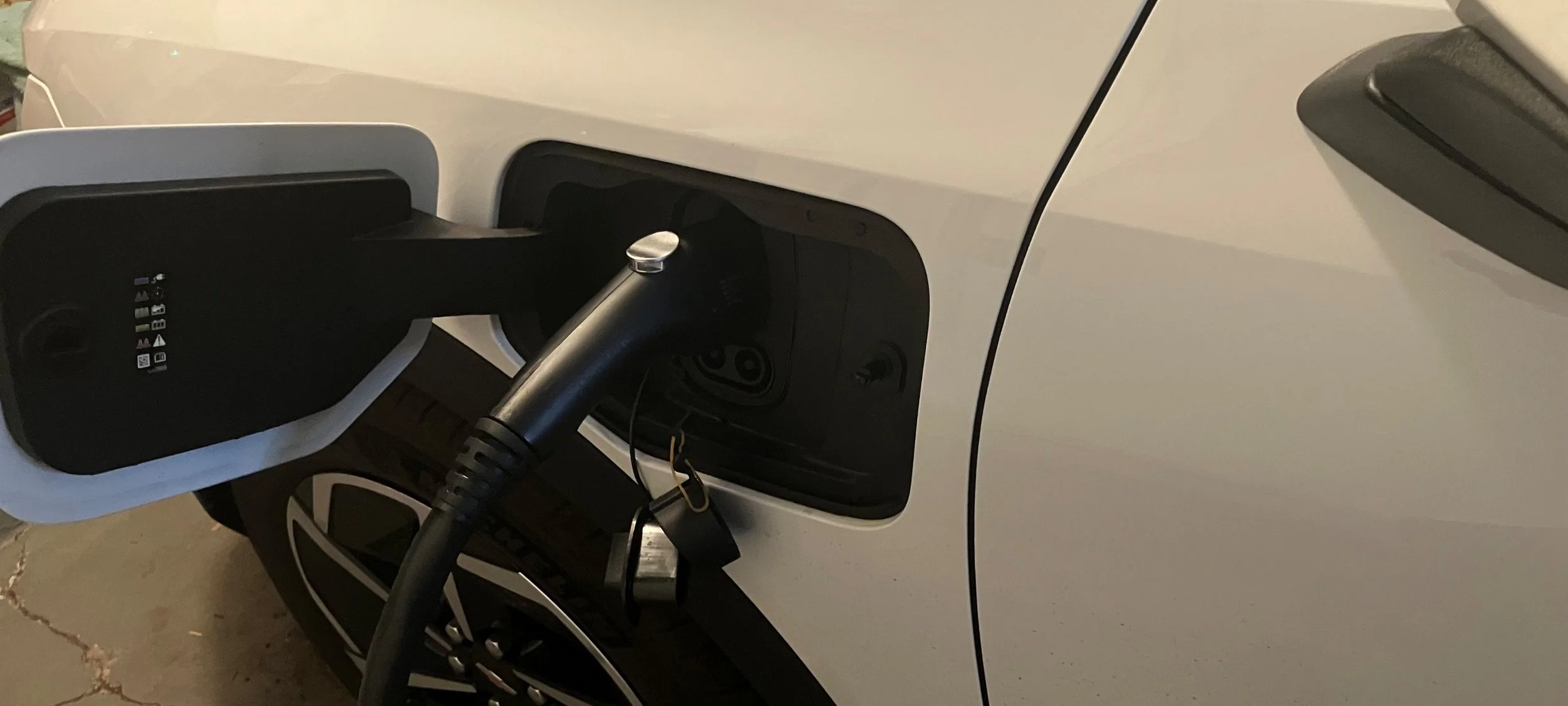
Recharging in the garage overnight
We bought our first EV in December 2024. This is a collection of things I wish I knew and might be of general interest, especially for anyone who needs to buy a car. The car we bought is a “battery electric vehicle” (BEV), differentiated from a “hybrid” or a “plug in hybrid”. The common gasoline powered vehicles are often called ICE, for internal combustion engine, but I have avoided using the ICE acronym because it can be confusing.
Range Anxiety
Long-distance travel was my biggest concern about going electric. After driving four round trips to Louisville and a 2,100-mile trip from Rockford to Savannah and back, we find that recharging is readily managed. The logistics have become something of a game.
My mental model has a budget of 10 hours for a 700-mile trip. In an EV, this same trip will take 11.5 hours. It turns out that the mental model doesn’t account for fuel, food, bio breaks, watering the dog. In the EV, all these tasks happen while we are charging. With a nominal range of 319 miles, we charge for 40–50 minutes every 4 hours, and the car is usually ready to go before we are.
Charging on the Road
The infrastructure is adequate, but not yet ideal.
The Tesla Adapter is Essential: We bought an adapter (from GM) to access the Tesla Supercharger network, which significantly multiplied our options. We learned the hard way that some of the early Tesla chargers only support Tesla vehicles. We had picked a hotel with Tesla chargers in the parking garage. Our first hint was that the chargers weren’t found using the on-board GPS.
Sometimes it Takes Two: Tesla cables are notoriously short because their cars back into spots. Since the Equinox charging port is in a different spot, I often take up two spaces to get the cable to reach. So far, we haven’t inconvenienced anyone using this method.
Finding Chargers: The on-board GPS is good at filtering for compatible chargers but isn’t comprehensive (we’ve used Rivian chargers that don’t show up). Having a co-pilot with Google Maps is helpful. I have a couple other apps that have been recommended but not yet downloaded (Charge Finder and Plug Share). We seek chargers with amenities within walking distance.
Diminishing Returns: It takes about as long to charge from 10% to 80% as it does from 80% to 100%. It’s probably time to get back on the road once you hit 80%.
Consider the Locals: Weekends in Champaign can be busy – presumably the college students in dorms / apartments don’t have the ability to plug in at “home”.
How to pay: The Tesla chargers require a credit card on file. All the others we’ve used take a credit card at the charger. The costs can be opaque, at least they don’t seem to be standardized in a way that allows easy comparison. What does $/kWh even mean? I’m more focused on getting back on the road and I’m confident that the costs per mile are about a third of that for a gasoline powered vehicle. To avoid idle charges, I set the target to 100%, although I know I will be done before that point. The providers use idle charges once you have stopped charging if you are still plugged in.
Free electrons! We attended an event at the local civic center. The parking lot was full except for an EV charging station (“Electric Vehicles Only”). I pulled in and then plugged in just to remove any doubt that the car met the posted criteria. After the event I realized that the car had been fully charged – unexpectedly, and at no cost. And a very convenient parking spot!
The Road Trip Bottom Line: We don’t hesitate to take the EV on road trips. At low temperatures the battery needs more frequent and longer duration charging. We haven’t had the opportunity to test this, but I feel that even a very cold road trip could be managed in an EV.
Specifications
For reasons I won’t go into here, I had decided on a Chevrolet Equinox EV without a lot of research. It turns out that most high-end EVs run on 400-volt or even 800-volt systems. The Equinox EV runs on 288 volts. This keeps the price low and limits the stress on electrical components but has a performance disadvantage, particularly if fast recharging is the objective. To protect the battery, the Equinox imposes a 150kW effective power limit. To reach the maximum charge rate on road trips, we need to find chargers with cables that can deliver a lot of current, and these typically are found on chargers rated at 350kW. At the risk of rationalizing a poorly researched decision, I will claim that the trade for price and reliability is worth the perhaps 10 minutes additional charge time on road trips.
Charging Around Town
The ideal EV owner drives it a lot every day and is able to recharge overnight. Driving many miles maximizes the environmental and economic benefit. “Many miles” is dependent on the range. For those who don’t have access to an outlet, that math gets constrained by the practical need to recharge on the weekends.
A “level one” charger plugs into the standard 110V wall outlet (for the Equinox, it’s a special cable that does not, incredibly, come standard with the vehicle). Level one provides a relatively slow charge rate and might work for topping up after a short commute each day. Pro Tip: if you visit a relative or friend it is good form to ask before plugging in.
A “level two” charger requires 220V electrical service. I ended up having a third-party charger installed in my garage – with the incentives at the time there was very little cost. When my GM cable came in, I realized that the Equinox has an integrated level 2 charger. It still would have required an electrician to install a 220V outlet, but the charger was unnecessary. Level 2 can be expected to fully recharge a vehicle overnight (< 8 hours).
· Fun fact: the 220V outlet for a level 2 charger is different than that used for a clothes dryer connection.
· Not so fun fact: Your breaker box doesn’t have unlimited capacity. Some homes might need more.
DC Fast chargers are level 3. You don’t need this at home, but they are critical for road trips.
Chevrolet recommends limiting the charge to 80% of range for daily use. When I sought guidance on how far to let the battery drain before recharging, the advice was ABC – always be charging. We typically charge once a week, to 80%, but we charge to 100% before a road trip.
Financial Considerations
Owning an EV is likely a net positive over an equivalent gas-powered car.
· An EV has a price premium over a comparable gas-powered vehicle. For the Equinox, that premium was about $5000, not counting the cost for the charging cables and the Tesla adapter. We took advantage of Federal and State rebates ($11,500 at the time), and the level 2 charger incentive was managed by ComEd.
· As for recurring costs, the car will never need an oil change and there is no catalytic converter for someone to steal.
· The thing weighs 1500 lbs. more than a comparable vehicle so I anticipate frequent tire rotations and a premium for special tires.
· Brake maintenance costs can be dramatically reduced by diligent use of dynamic braking and one-pedal driving.
· When considering operating costs per mile, the fuel cost is only 10% of what a gas-powered vehicle would experience. This is primarily a result of charging after midnight and using hourly billing through the electric utility (ComEd).
Environmental Considerations
Manufacturing an electric vehicle produces as much as twice the greenhouse gases as an equivalent gasoline powered car. EVs also increase particulates and road wear and tear due to their higher relative weight. Considerations:
· There are zero tailpipe emissions (there is no tailpipe).
· Ultimately, the electricity that is used to charge the battery determines the relative environmental benefit for driving an EV. The biggest benefit comes from charging with renewable energy (wind / solar) and nuclear.
· On average, it takes about 22,000 miles to break even environmentally in the US. In Northern Illinois where we have a grid full of nuclear, wind, and solar, the number is closer to 15,000 miles. Since our household has subscribed to community solar, we broke even after about 12,000 miles. Done.
· The more miles you drive, the bigger the benefit. That gas guzzler should be the emergency backup. For us, if the local Chevy dealer had a better service offering, we really could get by with one vehicle (and a bicycle). Don’t buy an EV if it is used to go to church once a week.
Impacts on Range
When driving long distances, maximizing the range converts into how many times you need to recharge. The stated range is nominal. The actual range depends…
· For the Equinox, the rated range is calculated at about 70°F. Above that and you are likely to exceed the rated range, although increased demand for air conditioning is an offset. Cold weather has a negative impact on range. Knowing this helps with recharge planning on long trips.
· Using dynamic braking increases range – it uses the electric motors as generators to convert the kinetic energy into voltage to recharge the battery (doesn’t work if the battery is at 100%)
· Use the seat warmers and steering wheel heater instead of raising cabin temperature (gas powered vehicles heat the cabin with waste heat from the engine)
The following considerations also impact range, but aren’t unique to EVs.
· Wind speed and direction: Aircraft can change altitude to minimize headwinds but an EV driver can only use the knowledge of wind speed and direction to aid in recharge planning. For us, a spring trip against a 40mph blustery wind resulted in an extra charging stop.
· Counterintuitively (to me, anyway) humid air is less dense than dry air at the same temperature. Range improves incrementally as humidity increases, but only to a point. All bets are off if it is raining.
· Slow down – wind resistance is a function of the square of the vehicle speed.
· Draft a semi – use the adaptive cruise control and tuck in behind – most fleet trucks are GPS and insurance motivated to observe the speed limit
· Proper tire inflation will impact rolling resistance. Today’s cars make it easy to know your tire pressure level (although those sensors have batteries with limited life and they will fail one at a time in close succession).
I know some if this is wacky – it’s funny how the lack of charging infrastructure has prompted my examination of physics that determine range. I never cared about this stuff in my old car. I guess cost wasn’t an issue? Most normal drivers don’t really need to think about this stuff.
My Wish List
· I want a bike rack. I wish I was more confident that the impact would be minimal.
· I wish there were better charge planning tools for long distance driving. The built in process is so conservative that we always have to have a parallel process.
· The car creates music-like noise at slow speed to avoid sneaking up on pedestrians. I want the option to change it up, like ring tones. My list: Darth Vader Theme, Theme from 2001: a Space Odyssey, and that ice cream truck jingle.
A Note on Objectivity
I’m aware of the "Endowment Effect" – a person tends to value things more when they own them. It’s hard to be perfectly objective when you’ve made this kind of commitment. But, we wouldn’t go back. I’m proud of our reduced impact on the environment, I’m happy with the economics, and it’s fun to drive. My opinion: if you need to buy a car, think seriously about going electric.